 Accepting Applications for the 2026-2027 School Year

Written by Lisa Woodall, Religion Teacher.
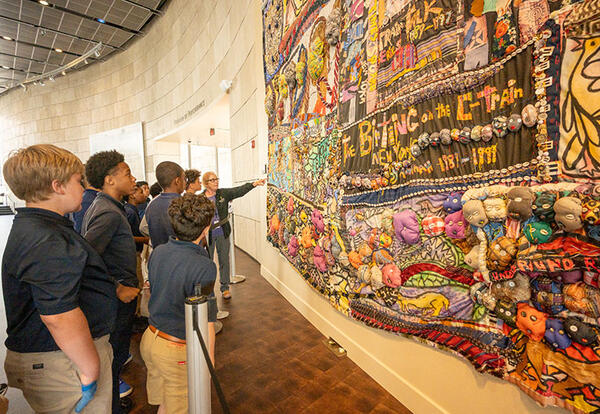
On Thursday, April 16, the 5th and 6th grades had the opportunity to visit the National Underground Railroad Freedom Center.
Before they could fully appreciate the rich history of the Freedom Center, however, the 5th and 6th graders studied some basic but essential lessons about the Atlantic Slave Trade, its impact on the Americas, Africa, and Europe, how it differed from slavery in other periods of world history, and the legacy of institutional racism that we are all called to address today.
We also talked about the very difficult nature of this subject, and we set the tone for our conversations with a quote from Colson Whitehead's Pulitzer Prize-winning historical fiction Underground Railroad describing what slavery was:
"Stolen bodies working stolen land. It was an engine that did not stop, its hungry boiler fed with blood."
After our visit, we connected the dots between the mission of the Freedom Center and Catholic Social Teaching, specifically the call to honor the human dignity of all people, without regard to race, gender, age, immigration status, faith tradition, economic group, or any other classification of humanity. Finally, we read and discussed a passage from Rev. Howard Thurman's book, Jesus and the Disinherited:
"Anything that restricts the blessings of liberty to a particular class, group, or type of human being is not only counter to the US Constitution, it also contributes directly to moral decay and it limits our ability to find freedom under God."
A few excerpts from the students' writing assignments following this field trip show some of what they took away from the experience:
"I think this is a sacred place like a church, and it gives important history."
"John Parker [was courageous] because he helped enslaved people escape to get across the Ohio River."
"Harriet Tubman [was courageous] because she cared about everyone, not just herself, and helped enslaved people escape to freedom."
"I feel lucky to have not lived in that time."
"Slavery was a horrible thing and slavery changed how we think about other races."
As evidence of the lasting impact of our visit, the students still had a few questions on their minds even a week after our field trip:
"Why does the KKK still exist?"
"Why if you were mixed race were you still considered Black?"
"Why did slavery even happen in the first place?"
...all great starting points for continued conversations in religion class about the need for everyone to pay attention to God calling us to honor the human dignity of everyone.
